

Strategy
Transformational ecosystems.
Two good models have been trying to do this work separately for decades. Both keep stalling in the same place. The ecosystem is our answer to why.
Last generation’s creative access;
our generation’s genuine identity.
Our businesses are not covers. They are honest companies with customers, payroll and competitors — which is what gives us a truthful public reason to live, serve and stay.
Visa
A legal reason to enter, and to keep coming back.
Credibility
A public life our neighbours can describe to each other.
Longevity
A pathway to stay long enough to disciple someone.
But access is not the goal. Access is only the beginning.
Legitimate presence, whole-life discipleship, generational transformation — that is the whole point, and it is why a business alone was never going to be enough.
The missing link
Three models. Two of them stall.
The second one is the trap, because from the outside it looks exactly like the answer — and a great deal of money and goodwill has gone into it.
Traditional missions
Disciplemakers + no business = little transformationSending agencies raise up and send genuine disciplemakers. But with no real marketplace identity they cannot secure long-term residence, cannot answer “what do you actually do here”, and rarely stay long enough to see a church stand on its own feet.
‘Christian’ business
Business + no disciplemakers = little transformationAn honest company, run on Christian principles, staffed by believers. It solves the access problem completely — and then stops. Nobody in it was ever trained to make a disciple, so the business grows while the people inside it stay exactly as they were. This is the one most supporters mistake for the goal.
The B4T ecosystem
Disciplemakers + workship = multiplying transformationBoth at once, on purpose. Real companies supply the legal standing, the income and the daily pressure; trained disciplemakers turn that pressure into formed character; and a local church gathers what comes out. Neither half is a means to the other.

Reading the architecture
Why it is built in tiers.
The picture above is not decoration — it is the org chart. Each tier does a job the others cannot, and each one is load-bearing.
Remove the dome and it is a holding company. Remove the B4T business and there is no access and no income. Remove the base and nobody can stay.
The tiers are also the order we build in. Property first, because it is slowest. Businesses second, because they fund and legitimise everything. The church is not last in importance — it is the point — but it grows out of people who are already working side by side.
Expansion
The next hub is founded by
somebody already inside this one.
Nothing here is meant to stay in one city. But we do not recruit founders from outside and hope they fit — new ventures are birthed from within existing ones, by people already formed by the pressure of running them.
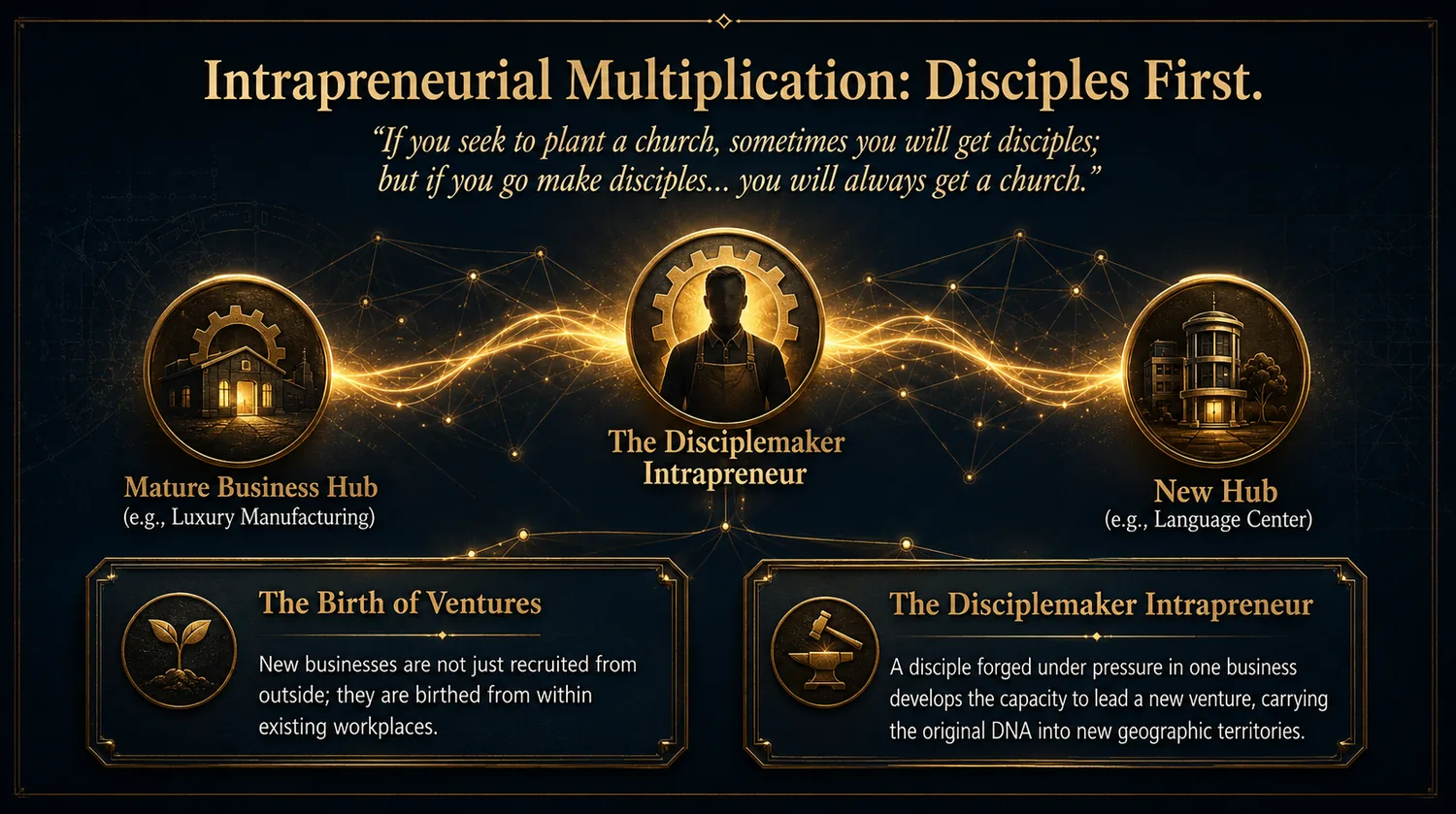
The mature hub
An established company with real customers, real pressure, and people who have been formed by both for years.
The intrapreneur
A disciple forged inside that business, who has carried responsibility long enough to be trusted with a venture of their own.
The new hub
A different trade in a different city, carrying the same DNA — because the founder learned it on the floor, not from a manual.
This is the unit we intend to reproduce across Central Asia.
A transformational view of work
Leave it at the door,
or bring it to the table.
Most companies ask people to check their real life at the entrance. We do the opposite — because the problem someone walks in with on Monday is usually the thing God is actually working on.

Compartmentalised faith
- Leave your problems at the door.
- Work is merely an economic transaction.
- The goal is to survive the week.
Integrated workship
- Bring your problems to the table.
- Work is an ecosystem for discipleship.
- The goal is spiritual transformation.
The workplace is not an environment to escape.
It is the primary forge for spiritual growth.
The catalyst
Character is forged
where the stakes are real.
We do not separate craftsmanship from Kingdom excellence. A missed delivery, a difficult client, a costly mistake, an employee who lies — these are not interruptions to discipleship. They are the curriculum, and a working company supplies them free of charge every week.
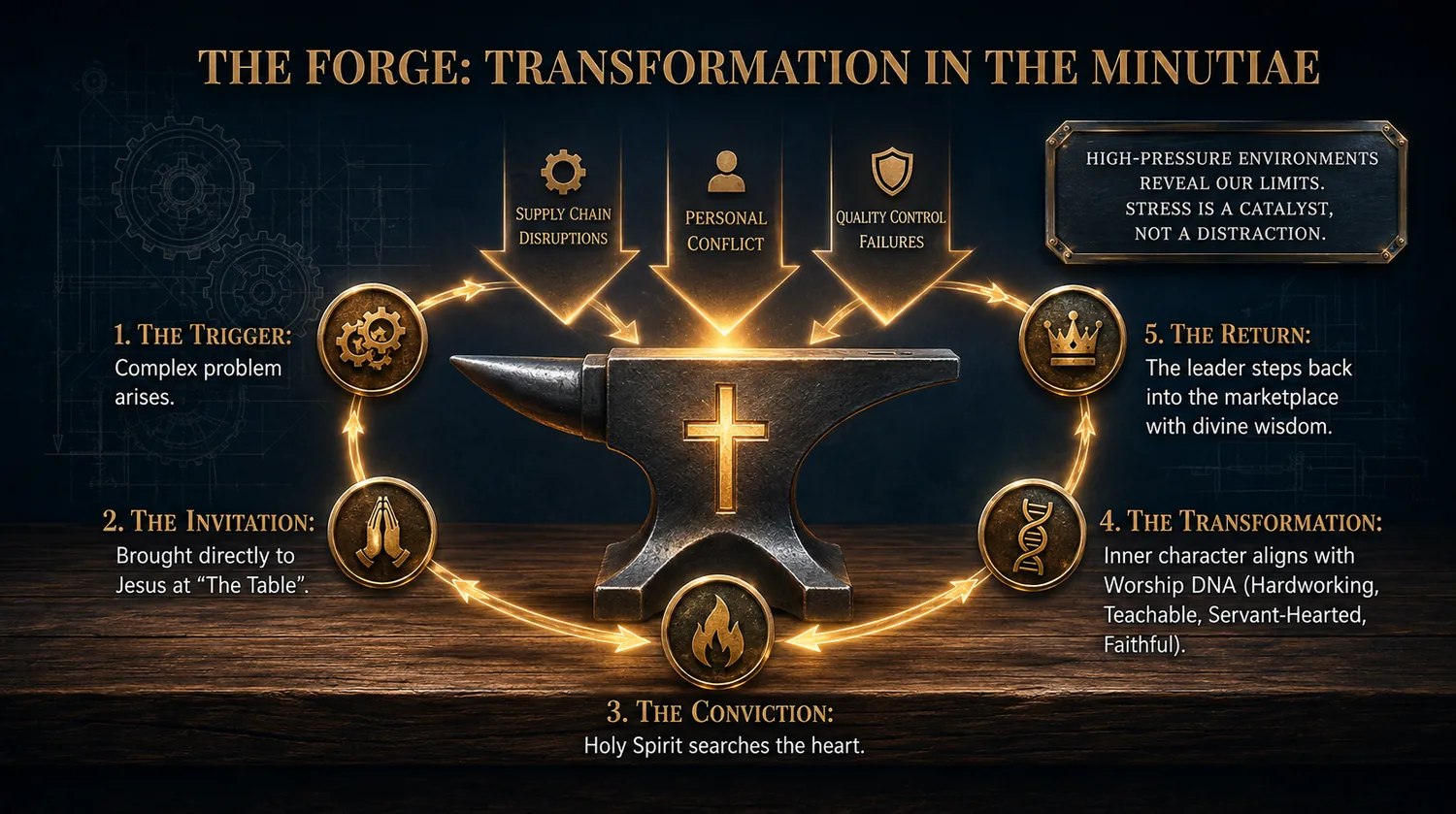
What comes down
A supply chain that fails the week it matters. Two good workers who cannot stand each other. A batch to be scrapped. A mistake somebody tried to hide.
What it exposes
Pressure reveals the limit of a person — where patience runs out, where honesty bends, what they reach for when tired. It happens in front of witnesses.
What rises
The Kingdom response: turning to God as the actual authority in the situation, exchanging a human reaction for divine wisdom, then going back and doing the work.
Stress is a catalyst, not a distraction.
It is the reason a business forms people faster than a seminary, and why leadership here is never granted on the strength of a degree.
Core values
The six marks of
someone who walks with God.
Not a company handbook. Six characteristics drawn from books our neighbours already hold to be holy — which is why they can be agreed on out loud, on the first day, by everyone in the room.
- 1HardworkingMatthew 25:21–30
- 2TeachableProverbs 18:15
- 3Servant-heartedMatthew 23:11
- 4Hungry to growMatthew 25:16
- 5FaithfulLuke 16:10
- 6Applies wisdomProverbs 3:5–6
Why these six, and why here
Common ground
for discipleship.
This is the mechanism that makes workplace discipleship possible in a place where you cannot simply preach. It rests on four steps, and every one of them is agreed upon rather than imposed.
We say so on day one, and it is not controversial. Our Muslim colleagues agree with the premise immediately — a company, like everything else, is held in trust and answerable to God. That single shared conviction changes what a workplace is allowed to talk about.
These six come from the Taurat, the books of Moses; from the Psalms of David and the Proverbs; and from the Injil, the gospels of Jesus. Christians and Muslims both name these as holy books of God. We are not importing a foreign standard — we are appealing to one already acknowledged.
If these are the marks of someone who walks with God, and we all say they are, then we can agree together to be measured by them — owners and apprentices and new hires alike, in both directions.
A conflict between two workers, who gets hired, who gets promoted, who has to be let go, a missed deadline, a covered-up mistake — each one gets brought back to the same six. The question stops being what does the boss want and becomes what does walking with God require of us here.
Ministry is causing people to sit
at the table with the Lord Jesus.
That is the whole job. We are not trying to win an argument at work; we are trying to get people to the table. And it is at that table, not in anything we say, that the Holy Spirit does His work.
The ripple effect
Transformation leaks outward.
When character is forged in ordinary work, the fruit does not stay at work. The goal was never simply a changed employee. It is transformed households, and after them, transformed communities.
 01Individual
02Home
03Community
04Generations
01Individual
02Home
03Community
04Generations
- 01 Individual Character refined — in front of witnesses, under real pressure.
- 02 Home Relationships restored. A changed man is a different husband and father by Friday.
- 03 Community Witness becomes visible, because neighbours can see the difference and name it.
- 04 Generations Blessing outlasts us — children raised inside a household that already believes.
The five parts
One ecosystem, described by function.
Because of where we work, we name our companies by the job they do rather than by brand. Each is a genuine business with real customers and real payroll — and each produces a different kind of leader.
Luxury outdoor living & construction
High-end craftsmanship that opens doors into the wealthiest and most influential households in the region — people almost no ministry reaches. Manufacturing on deadline for clients who expect perfection generates the exact problems that expose and refine character.
You would join as a fabricator, site manager, designer, estimator or operations lead.
A language & learning centre
We train local young people to teach, not merely to speak. Learning how to learn and how to teach is the same skill discipleship runs on, and education is a bridge of trust: the act of teaching a language opens a heart.
You would join as a teacher, teacher-trainer, curriculum developer or centre manager.
A professional cleaning service
Dignified, properly paid work for women coming out of very hard situations. Excellence in service becomes the instrument of restoration, and proves there is no lowly work in the Kingdom.
You would join as a trainer, scheduler, quality lead or operations manager.
A local New Testament assembly
The church is God’s ordained method for making disciples and the hub the whole ecosystem answers to. Led by a plurality of bi-vocational elders who work in the businesses midweek and shepherd the flock on the weekend.
A holding & property company
The land, the factory floor, the training centre and the housing. Owning our own footprint is what makes a 24/7 discipleship environment — and long-term security — possible at all.
Business supplies the access and the problems. The campus supplies the proximity. The church supplies the authority. The 153 come out the other side.
The EquipKing Center
A receiving, equipping
and launching pad.
One place that takes people in, forms them, and sends them out. Work, worship and service under one roof — and disciplemakers who make disciplemakers going out from it across Central Asia.

Newcomers arrive into a household, not a hotel. Housing, a place at the table, and people who have already done what they are about to do.
A working floor below, classrooms above, the assembly across the street. Trade, language, Scripture and business training in the same building, on the same day.
Teams go out from here to the next city with a trade, a company, a language and a church behind them — and come back through for resupply and correction.
Work
A real company on the ground floor, where character is tested and skill is earned.
Worship
An assembly that gathers around the table, led by the people you work beside all week.
Service
A community that is measurably better off because we are in it — and knows why.